Which 3D printing material do I need? Quick answers
The questions people ask most, answered in one line each. The full detail for each material follows below.
Strongest 3D printing material
Nylon carbon fibre, at around 100 MPa tensile strength and 150 °C heat resistance. For most brackets, PETG or carbon fibre PETG is strong enough at a fraction of the cost.
Waterproof 3D printing
PETG, ASA and nylon resist water and most workshop chemicals. For a part that must hold water, print it solid or at 100% infill and tell us in the order note; FDM parts are not pressure vessels.
Flexible and rubber-like parts
TPU 95A. It bends and springs back, resists abrasion and oils, and suits grips, seals, bumpers and covers. We do not print silicone.
Heat-resistant parts
ASA to about 95 °C, nylon to about 100 °C, nylon carbon fibre to about 150 °C, PEEK to about 250 °C. PLA softens at 55 °C and is wrong for anything near an engine or a window.
Finest detail and smoothest surface
Resin at 0.1 mm layers. Grey for general detail, clear for transparent parts, tough for anything that gets handled. SLS nylon has no layer lines but a fine grainy texture.
ABS 3D printing
We print ASA instead of ABS. It has the same strength and toughness with better UV resistance and far less warping, so it is the better choice for every job ABS is usually chosen for.
FDM 3D printing materials, next day
FDM is the process for most functional parts and every prototype round. All values are typical datasheet figures for the filaments we print with; ask for the datasheet with your order.
| Material | Choose it for | Not ideal for | Tensile | Heat limit | Finish |
|---|---|---|---|---|---|
| PLA | Visual prototypes, presentation parts, indoor housings, checking size and shape before a tougher material. Sands, primes and paints well. | Heat above 55 °C, outdoor UV, heavy loads or impacts. | ~55 MPa | ~55 °C | Crisp, matte, widest colour range |
| PETG | Brackets, housings, jigs and snap-fits that get handled or knocked. Less brittle than PLA, resists water and common chemicals. | Long-term outdoor sun (choose ASA) or heat well above 75 °C. | ~50 MPa | ~75 °C | Smooth with a slight gloss |
| ASA | Outdoor parts, signage, exterior and automotive trim, anything in sunlight. Strong, UV stable, moisture resistant. | Very thin walls, which can split; maximum impact toughness (PETG is better in thin sections). | ~45 MPa | ~95 °C | Matte, UV stable |
| TPU 95A | Grips, seals, gaskets, bumpers, feet, straps, protective covers. Semi-flexible: bends and springs back, resists abrasion and oils. | Rigid, dimensionally critical parts; heat above about 60 °C; designs needing lots of support removal. | Flexible | ~60 °C | Rubber-like |
| Nylon | Gears, bearings, hinges, guides and wear parts. Low friction, tough, resists oils and fuels, performs in warm environments. | Intricate geometry with thin sections and heavy overhangs, which print less reliably in nylon. | ~55 MPa | ~100 °C | Slightly textured |
| Carbon fibre PETG | Brackets, mounts, housings, hinge blocks, jigs and fixtures that must hold their shape under load. Stiffer than PETG, premium matte finish. | Parts that must flex or snap-fit repeatedly; very intricate features. | ~60 MPa | ~80 °C | Matte black, hides layer lines |
| Nylon carbon fibre | Load-bearing brackets, clamps, precision fixtures, machine and automotive-adjacent parts where strength to weight matters. The strongest material we print. | Parts that must flex, or tight tolerances in wet or humid conditions (nylon absorbs moisture). | ~100 MPa | ~150 °C | Matte, machined look |
| PEEK | Parts that run at up to 250 °C, in aggressive chemicals or under constant load: aerospace, oil and gas, semiconductor, bearings and bushings. Flame retardant, UL94 V-0. | General prototypes or visual parts, where nylon, ASA or PETG does the job at a fraction of the price. Printed to order and annealed; ask before uploading. | ~95 MPa | ~250 °C | Tan, matte |
Resin (SLA) 3D printing service, next day
Resin prints at 0.1 mm layers with a smooth surface straight off the printer, and captures text, threads and small features that FDM blurs. Three resins cover most jobs, and all three can be ordered before 12:00 for next working day delivery. Resin parts weaken under long-term UV, so they are indoor materials.
Grey resin
General-purpose. Rich matte grey, accurate on small features, good chemical resistance to workshop fluids, heat deflection about 71 °C. Form-and-fit prototypes, presentation models, jigs.
Clear resin
Transparent parts: light pipes, lens prototypes, fluid-flow models, optical housings. Polishable to near-optical clarity, 85% light transmission at 2 mm. Hard and glass-like, so not for impact loads.
Tough resin
ABS-like toughness with 79% elongation at break. Snap-fits, enclosures, brackets and handheld housings that get used, not just looked at. Heat deflection about 70 °C, dark matte finish.
SLS nylon PA12 3D printing service
Selective laser sintering builds nylon parts in a bed of powder, so there are no supports, no support marks and strength that is close to equal in every direction. It is the process used for many production runs, so it suits the final check before production and short runs of end-use parts: housings, brackets, ducts, clips, snap-fits and moving assemblies printed in one piece.
Tensile strength about 48 MPa, heat deflection about 175 °C, a fine matte grainy texture that takes dye well. SLS nylon is dispatched in 10 working days and has a £30 minimum order. It is priced in the same tool, from the same file, beside the FDM and resin prices.
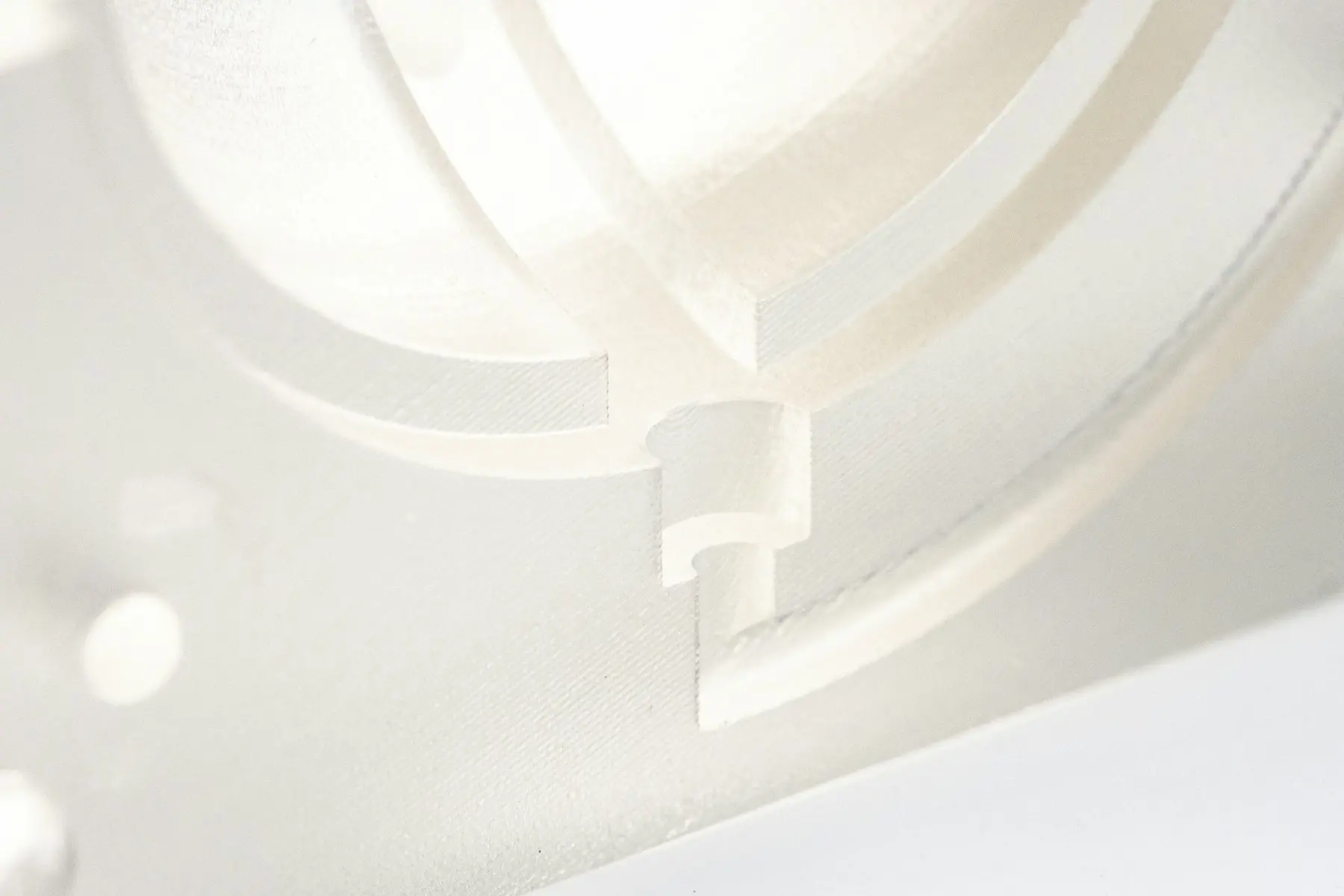
Tolerances, wall thickness, infill, supports, layer height and resolution
The practical numbers behind every NextDay3D part. The quote tool checks your file against them before you pay.
Tolerance
FDM: ±0.2 mm or ±0.5% of the dimension, whichever is greater. Resin: about ±0.1 mm on small features. Holes print slightly under size on every process and are best reamed or drilled to final fit.
Wall thickness
Design walls at 1.5 mm or more for FDM, 2 mm for parts that will be loaded. The tool measures your thinnest wall and flags anything under 1.5 mm before you pay. Resin walls can go to 1 mm.
Infill
20% is the default and is strong enough for most housings and brackets. 50% for parts that are screwed or loaded. 100% for small parts that must be solid, watertight or machined afterwards.
Supports
Overhangs beyond about 45 degrees get support material, which is removed by hand and the contact points cleaned before packing. Orientation is set to minimise supports on the surfaces that matter.
Layer height and resolution
0.2 mm layers on FDM, which are visible as fine lines. 0.1 mm on resin and SLS. Choose sanded in the tool for a smoother FDM finish.
Large format 3D printing
Parts over 500 mm long and 480 mm tall have been printed in one piece on our own printers. Upload the file and the tool says whether it fits; bigger parts are printed in sections and joined, and a person confirms the approach before you pay.
Materials questions
What is the strongest 3D printing material?
Of the materials NextDay3D prints, nylon carbon fibre is the strongest at around 100 MPa tensile strength with a heat limit near 150 °C, followed by PEEK for extreme temperatures and chemicals. For most brackets and fixtures, carbon fibre PETG at about 60 MPa is strong enough and much cheaper.
Can you 3D print rubber or silicone?
Rubber-like, yes: TPU 95A is semi-flexible, bends and springs back, and resists abrasion and oils. Silicone, no. NextDay3D does not print silicone or cast it.
Can you 3D print carbon fibre?
Yes. NextDay3D prints carbon fibre PETG and nylon carbon fibre, both available next day. They are chopped-fibre filaments: stiffer and more stable than the base plastic, with a matte finish that hides layer lines, but not as strong as continuous carbon fibre composites.
Can you 3D print metal?
No. NextDay3D prints plastics only: FDM, resin and SLS nylon. For metal parts you need a metal additive or CNC bureau, and many engineers print the plastic version here first, next day, to check fit before paying for metal.
Do you print ABS?
NextDay3D prints ASA in place of ABS. ASA matches ABS for strength and toughness, is more UV stable, and warps far less, so it is the better choice for the enclosures, automotive trim and outdoor parts ABS is usually chosen for.
Which material is best for outdoor parts?
ASA. It is UV and weather resistant and holds up to sunlight without fading or cracking. PETG is a reasonable second choice for parts that are sheltered. PLA and resin are indoor materials.
Which 3D printing materials can be delivered next day?
All FDM materials at NextDay3D (PLA, PETG, ASA, TPU, nylon, carbon fibre PETG and nylon carbon fibre) and all three resins (grey, clear and tough) can be ordered before 12:00 for delivery the next working day. SLS nylon PA12 takes 10 working days and PEEK is printed to order.
Are 3D printed parts food safe?
No. NextDay3D parts are not certified food safe. FDM layers trap bacteria and the filaments are not certified for food contact, so printed parts should not be used for food or drink.
What tolerance does FDM 3D printing hold?
±0.2 mm or ±0.5% of the dimension, whichever is greater, at NextDay3D. Resin holds about ±0.1 mm on small features. Put critical dimensions in the order note and the part is oriented to hold them.